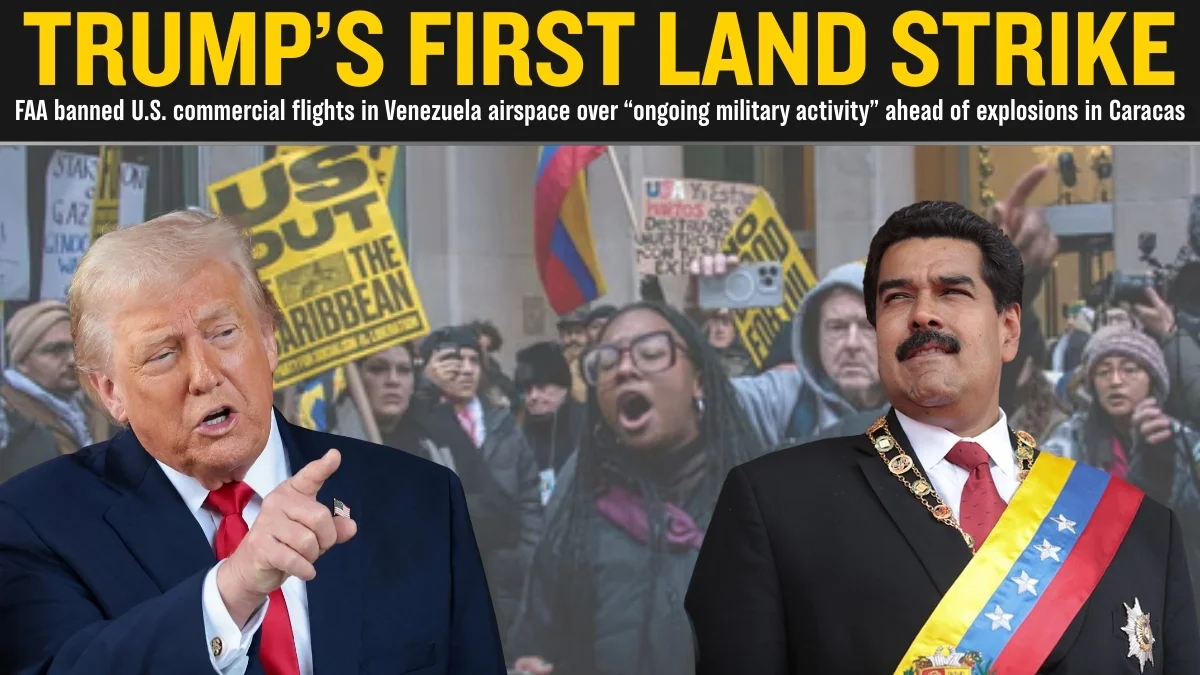
In the early hours of January 3, the political map of the Western Hemisphere appeared to tilt suddenly and violently. According to a statement by Donald Trump, U.S. forces carried out what he described as a “large-scale strike” in Venezuela, culminating in the capture and removal of President Nicolas Maduro from the country.
Explosions echoed across Caracas, aircraft reportedly flew low over the capital, and Venezuelan authorities accused Washington of attacking both civilian and military sites. U.S. media outlets reported active military operations, yet by daybreak there were no formal statements from the White House or the Pentagon. The silence only deepened the sense that the world was witnessing a turning point one whose consequences remain uncertain.
Why This Moment Matters
If confirmed, the removal of a sitting head of state by a foreign military would mark one of the most consequential U.S. interventions in Latin America in decades. Unlike sanctions, diplomatic isolation, or covert pressure tools long used against the Maduro government this would represent a direct and irreversible action.
For Venezuela, a nation already fractured by economic collapse, mass emigration, and political repression, the stakes could not be higher. Maduro has been both the symbol and the enforcer of a system that survived years of sanctions and internal opposition. His sudden absence creates a power vacuum that could either open a path toward transition or plunge the country into deeper instability.
For the region, the implications stretch far beyond Venezuela’s borders. Latin American governments many of which have worked to keep Washington’s military footprint at arm’s length since the Cold War now face a precedent that could reshape diplomatic alignments overnight.
Reading Between the Lines of Washington’s Silence
The lack of immediate confirmation from U.S. institutions is not incidental. In moments like this, ambiguity serves a purpose. It allows Washington to manage escalation, gauge international reaction, and retain leverage while facts on the ground solidify.
From a strategic standpoint, the reported operation suggests a calculation that pressure alone had reached its limits. For years, U.S. policy aimed to weaken Maduro’s grip through economic isolation and diplomatic recognition of opposition figures. Those efforts failed to produce a change in leadership. A kinetic move if that is indeed what occurred signals a belief that the status quo had become more dangerous than the risks of intervention.
What Happens Inside Venezuela Now?
The most immediate question is not where Maduro has been taken, but who controls the state apparatus in his absence.
- The military: Venezuela’s armed forces have been the backbone of Maduro’s survival. Their response whether fragmentation, resistance, or negotiated alignment with a transitional authority will determine the country’s trajectory.
- The opposition: Long divided and weakened, opposition leaders may see an opening, but legitimacy will depend on whether any new political arrangement is seen as Venezuelan-led rather than imposed from abroad.
- The streets: Ordinary Venezuelans, exhausted by years of crisis, could react with hope, fear, or both. Spontaneous protests or unrest are likely if clarity does not emerge quickly.
Global and Future Implications
Internationally, the reported operation is certain to ignite debate at the United Nations and strain U.S. relations with countries that have supported or tolerated Maduro, including Russia, China, and Iran. How those actors respond diplomatically or otherwise will shape the next phase.
Looking ahead, the central issue will be legitimacy. Removing a leader is far easier than building a stable successor system. If the aftermath descends into chaos, the intervention could be remembered as a cautionary tale. If it leads to a credible transition, it may redefine how external powers justify action against entrenched authoritarian regimes.
The Unanswered Question
For now, much remains unverified. What is clear is that the events reported from Caracas mark a rupture in a long-running standoff. Whether this becomes the beginning of Venezuela’s political reset or the opening chapter of a far more dangerous confrontation will depend on decisions made in the coming days, not on the explosions that announced this moment to the world.